Freedom Tunnel
I remember spending an evening with Lee Stringer a few years ago, his story of living a semi underground life in the subway system of NY is poetically captured in his memoir Grand Central Winter, and so when I stumbled upon this article about the Freedom Tunnel in NY I was captured by the notion of freedom and its location. Take a look and see.
Frederic Malle
Very happily introduced to the work of Frederic Malle recently and have indulged in the Musc Ravageur which is one of my favourite scents. There’s a great explanation of the concept by the man himself which is worth a look, although the real experience is the scent, get along to the nearest vendor for a sniff.
DeTank video
This recent interview with Philip Wood by Max Frazer was filmed at Tent London part of the Design Festival that happens in London each year. Max Frazer’s career spans print and television journalism as well as being the author of three books including his most recent monograph on the contemporary Dutch designer Piet Hein Eek entitled Boek: Piet Hein Eek
Create Reject
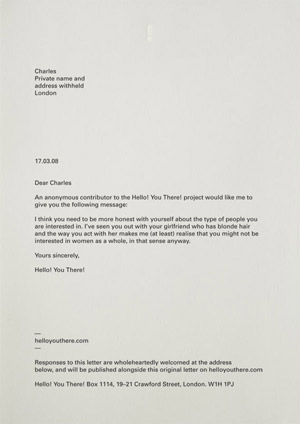
Whilst in London for 100% design I managed to meet with James West who is the creative brains behind various projects that you’ll be familiar with such as Hello! You There! which the image above is from, he says of the project “You can use this site to send anonymous, constructive advice to anyone about anything you like. Your advice will be sent by post. It can be trivial or devastatingly important but the key is for it to be constructive.The hope is that, over time, this project will have triggered lots of small, seemingly insignificant changes that collectively might make a slight contribution to a better society.”
He was also behind the recent FIFTY DESIGNERS’ CURRENT FAVOURITE TYPEFACES (UNICEF) and some other equally beautiful projects all of which are viewable at Create Reject I hope we have the chance to collaborate in the future, this hopefully could start with an inclusion in issue#2 his self published magazine.
Blurring The Boundaries

At the moment it comes out of my mouth, I know I’ve said something that I neither whole heartedly believe in nor fully understand. “Blurring the boundaries between art and design”, I say. It sounds just so exciting. I’d love to go and blur some of those boundaries. In fact, I envision it as something like the dismantling of the Berlin wall, a sort of righteous attack on the artifice of the old guard that had been left standing by our own complacency. There are many un-thought through phrases that spin out of mine and, dare I say, many of your mouths yet blurring boundaries is one that can be heard all too often these days, particularly in galleries, showrooms and magazines just like the one you’re holding now.
The examples we are offered of blurring boundaries between art and design often don’t stand up to scrutiny. For instance, selling design in an art gallery format doesn’t make it art. Limiting the number of items you produce doesn’t make it art. Taking a standard design item from your range and painting it another colour also does not make it art. And, by the way, it doesn’t blur any boundaries. I’m not against all of the work that turns up this way, but let’s not suggest it is something that it’s not, nor that it’s doing something that it isn’t.
What seems more pertinent is the morphing topology of the market we’ve seen recently in both worlds, by the likes of dePury’s launching into the commissioning of work by designers themselves rather than waiting for a secondary market to wash the work upon the shore of their salerooms. Or Damian Hirst’s (he gets everywhere doesn’t he?) Royal warrant of approval being layed upon Christie’s to great media effect this month as he sells directly to the bidding audience a collation of his recent work. This sets a precedent and maybe, with it, offers a glimpse, an alternate future, of the art market.
I personally find an increasing strain in decoding cultural lexicons through the various obfuscating lenses the world is viewed through today that I need no further blurring, thank you very much. In fact, what I’d like is a huge light shone upon the boundaries so that I can more clearly see them. Call for an optometrist and some Halogen lights (CFL’s and the greening of design, we’ll come to that at another time). I don’t need to be seeing the world through the wrong end of a telescope.
We’ve seen boundaries being blurred, smudged and dismissed as non existent, in an attempt to suggest they’re no longer relevant. Segregation in the U.S.A. and Apartied in South Africa could only be assessed and brought down as the tyrannical regimes that they were by highlighting them. Emancipation from existing thinking doesn’t come from the blurring of boundaries, it comes from clearly understanding their nature and location.
And if mapping out and drawing of lines may seem far too colonial a pursuit, then be reassured the location of cultural boundaries are more mercurial than those drawn on political maps. They may be porous but they do exist and the location where ideas or bodies meet is almost always the most interesting and telling of moments.
PHILIP WOOD
BDDW
I’m not jealous by character, I’m happy for others in the main but the moment I by accident stepped into the NY showrooms of BDDW, in Crosby Street some years ago my joy sooned turned to jealousy. I spent almost 13 years as a furniture and cabinet maker based in rural England, even building my business to fifteen staff and developing a 10,000 sq ft 1750’s former Malthouse into workshops and gallery store, but never did I get to acheive the level of understated perfection that BDDW has. Like all things slightly transendental it’s difficult to understand quite what makes them so, greater than the sum of their parts. The work of BDDW answers one of my most fervent complaints towards craft, that it rarely amalgamates design. I’ve seen far too many high end craft pieces where the maker may have spent 300 hours on the construction yet only maybe 2 hours on design, BDDW’s work takes a more balanced and ultimately much more successful approach.
Tomas Kral: Upgrade
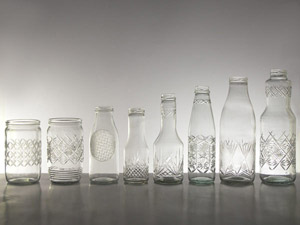
Just back from London for Design Week:, visiting a whole range of people and work. One of the best things I saw was this body of work by Tomas Kral, who I met at 100% design and then again at Libby Sellers party in Libertys. It’s like many of the best works I’ve come across being both very obvious and very sophisticated, it’s execution is also well done. I hope we’ll be able to work with him soon.